🧵 AI Fashion Weekly Recap
Week of March 29 – April 4, 2026
By AI Disc Jockey | AI Fashion News — Intersection of Style & Innovation – No 26
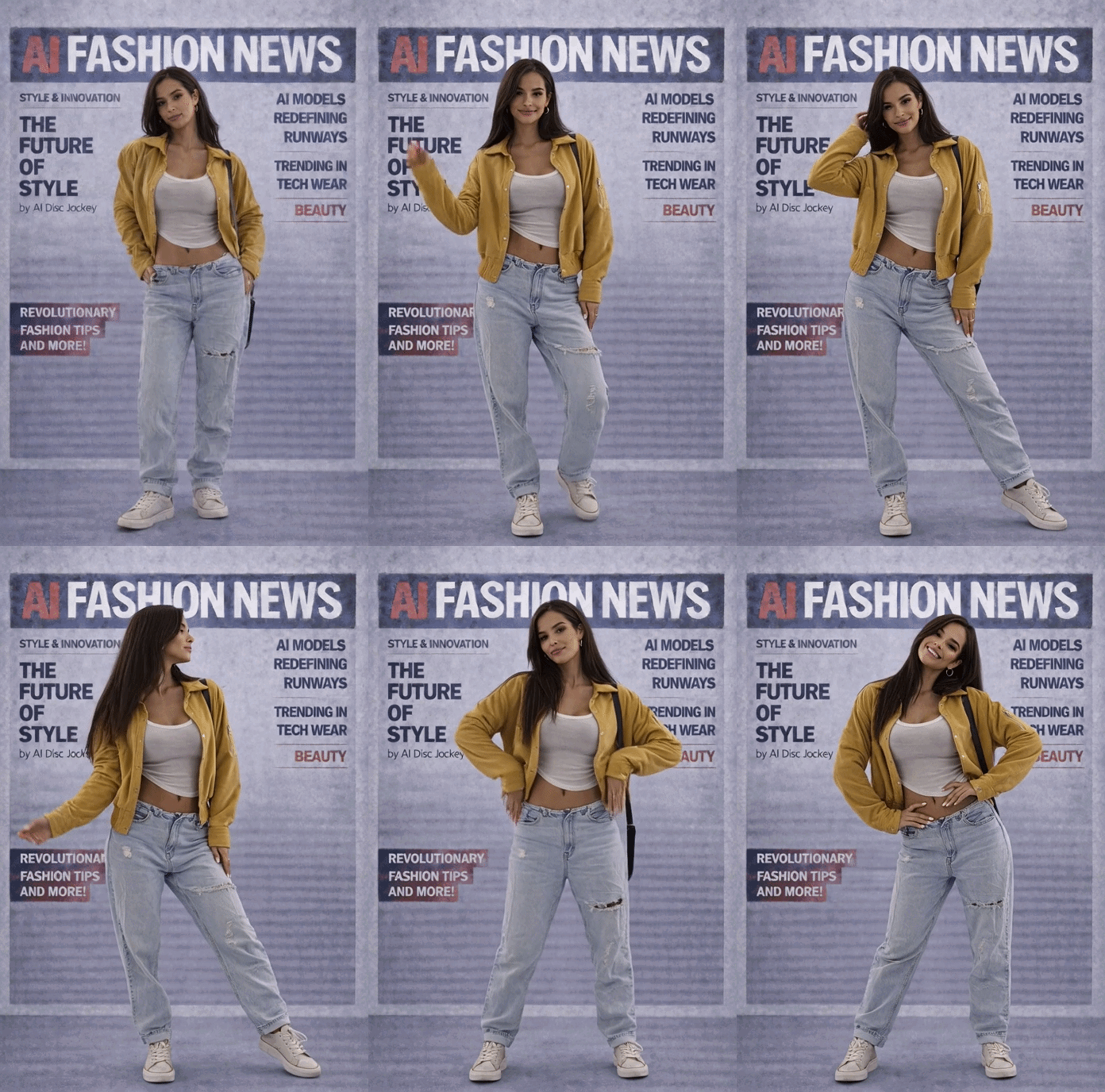
This week, AI didn’t just push fashion and beauty forward—it quietly redefined the entire system beneath them. From agentic shopping and AI wellness advisors to resale acceleration and infrastructure-level sustainability breakthroughs, the industry is moving beyond experimentation into full-scale integration. What’s emerging is a new reality where AI is not a feature, but the foundation—powering discovery, decision-making, and operations across every layer of the fashion and beauty stack.
AI Shopping Agents Are Reshaping Retail Behavior
At Shoptalk 2026, fashion leaders made one thing clear: AI-powered shopping agents have officially moved from experimental to operational. As reported by Vogue, these systems are evolving into what insiders are calling “agentic commerce”—where AI doesn’t just recommend products but actively shops, curates, and even negotiates on behalf of consumers. This marks a profound shift away from traditional search-based retail into AI-directed discovery, where algorithms—not storefronts—control visibility and decision-making.
The implications are massive. The concept of a “storefront” is beginning to dissolve as AI becomes the primary interface between consumer and brand. Instead of optimizing for human browsing behavior, brands must now optimize for machine interpretation—training datasets, metadata, and algorithmic relevance. Retail is no longer about attracting attention; it’s about being selected by AI.
Why It Matters: Retail is shifting from search-driven to AI-directed discovery, Brands must optimize for algorithms, not just consumers, The storefront is becoming invisible, AI is emerging as the primary interface between consumer and brand
AI Wellness Chatbots Become “Table Stakes”
AI-powered wellness advisors are rapidly becoming foundational tools across beauty and supplement brands. According to Glossy, platforms like Thorne’s “Taia” are driving higher engagement and increased order values, signaling a major behavioral shift. These AI systems are evolving into daily decision engines, guiding consumers through personalized wellness and beauty routines with real-time recommendations.
This transformation reflects a broader convergence of beauty, health, and longevity ecosystems. AI is no longer just enhancing product discovery—it’s embedding itself into everyday lifestyle decisions. As adoption accelerates, the expectation is clear: every major beauty and wellness brand will deploy AI advisors as a standard part of the user experience.
Why It Matters: AI advisors are becoming standard UX in beauty and wellness, Higher engagement and order values driven by personalization, Beauty is merging with health and longevity ecosystems, AI is evolving into a daily decision engine
AI Powers $289B Resale Fashion Boom
The global resale fashion market is projected to reach $289 billion in 2026, with AI serving as a core engine behind this explosive growth. As highlighted by The Guardian, platforms like Vinted, Depop, and ThredUp are leveraging AI to catalog inventory at scale, improve search precision, and deliver hyper-personalized discovery experiences.
This shift signals a deeper transformation in consumer behavior—from “buy new” to “buy smarter.” AI is now acting as stylist, merchandiser, and sustainability advocate simultaneously, making secondhand fashion more accessible, desirable, and efficient. Ownership itself is being redefined through algorithmic intelligence.
Why It Matters: Resale market projected to hit $289B, AI enables scalable inventory and personalization, Shift from “buy new” to “buy smarter”, AI drives both convenience and sustainability
AI Textile Sorting Breakthrough Reduces Waste
A major breakthrough in AI-powered textile sorting is reshaping the sustainability infrastructure of fashion. According to AP News, new systems can sort up to 100 kilograms of clothing in minutes—dramatically outperforming human labor while improving accuracy. Even more impactful, these systems reduce unusable waste from 50% to 30%, marking a significant leap in recycling efficiency.
While less visible than consumer-facing AI, this represents the backbone of the circular fashion economy. AI is enabling the industry to move beyond sustainability as a marketing narrative and into real, scalable operational change. This is where long-term environmental impact is truly being built.
Why It Matters: AI dramatically improves textile sorting efficiency, Waste reduction from 50% to 30%, Enables scalable circular fashion infrastructure, Sustainability shifts from messaging to execution
AI Is Quietly Rewiring the Entire Fashion Stack
Beyond the headlines, AI is fundamentally transforming the operational core of fashion. Insights from Veeton highlight how AI is automating product descriptions, translations, and backend data systems. At the same time, nearly 25% of shoppers are now beginning their journey with generative AI instead of traditional search engines.
This is compressing design cycles and enabling brands to respond to trends in real time. The result is a fully integrated, AI-driven fashion stack—from ideation to merchandising to customer interaction. The brands that win will be those that embed AI deeply across every layer of their operations.
Why It Matters: AI automates core fashion operations, 25% of shoppers start with generative AI, Design cycles are shrinking dramatically, AI is becoming embedded across the entire fashion stack
AI Regulation & “Digital Doubles” Enter Beauty
Legal frameworks are rapidly evolving to address the rise of AI-generated likenesses, often referred to as “digital doubles.” According to The Global Legal Post, new discussions are focusing on transparency in training data, consent, and intellectual property rights tied to digital identities.
For beauty and fashion brands, this introduces a new layer of complexity. The use of AI-generated faces, influencers, and likenesses must now be carefully managed within emerging legal boundaries. Identity itself is becoming a regulated asset in the AI era.
Why It Matters: AI-generated likeness raises new legal challenges, Increased focus on consent and IP rights, Transparency in training data becoming essential, Identity becomes a regulated digital asset
Global Beauty Market Surges 10%—AI Driving a $500B Industry
The global beauty market is experiencing strong growth, projected to surpass $500 billion, with AI playing a central role. Reporting from National Today highlights how AI-powered e-commerce is accelerating this expansion, with online sales growing six times faster than physical retail.
AI is no longer a side experiment—it’s a core growth engine. From personalized recommendations to supply chain optimization, AI is driving efficiency and revenue across the entire beauty ecosystem. The digital channel is now the primary battleground for growth.
Why It Matters: Beauty market approaching $500B, AI driving e-commerce acceleration, Online sales growing 6x faster than in-store, AI is now a primary growth driver
L’Oréal: Data First, AI Second
Inside L’Oréal’s AI strategy, one principle stands out: data is the true competitive advantage. As detailed by BeautyMatter, the company has built massive datasets—over 14,500 terabytes—before scaling AI deployment across initiatives like molecule discovery and foundation shade matching.
This reinforces a critical insight: AI is only as powerful as the data behind it. The future leaders in beauty will not just be those with the best algorithms, but those with the richest, most structured datasets powering them.
Why It Matters: Data is the foundation of AI success, Massive datasets enable advanced innovation, AI accelerates R&D and personalization, Competitive advantage shifts to data ownership
Ingredient-Level AI Intelligence Becomes the New Battleground
A new frontier in beauty e-commerce is emerging: ingredient-level intelligence. According to EIN Presswire, platforms like Inference Beauty are enabling AI systems to deeply understand product composition, functionality, and user suitability.
This represents a shift from marketing-driven storytelling to structured, machine-readable data. Consumers—and algorithms—can now evaluate products based on what’s actually inside them, not just how they’re positioned. Transparency and precision are becoming competitive advantages.
Why It Matters: Shift from storytelling to structured data, Ingredient-level intelligence drives decisions, Increased transparency for consumers, AI enables deeper product understanding
E.l.f. Beauty Defines Its AI Playbook
e.l.f. Beauty is helping define how brands should approach AI adoption. In an executive interview covered by Modern Retail, the company outlined a four-pillar strategy: customer-centric use cases, brand authenticity, measurable ROI, and responsible deployment.
Rather than rushing into generative AI, the brand is taking a disciplined, strategic approach. This signals a maturation in how the industry is thinking about AI—not as a novelty, but as a long-term capability that must be aligned with brand values and business outcomes.
Why It Matters: AI strategy requires clear guardrails, Focus on ROI and customer value, Brand authenticity remains critical, Responsible AI deployment is essential
AllSaints Leans Into AI for Merchandising Precision
Fashion brand AllSaints is leveraging AI to optimize merchandising and inventory decisions through its partnership with Impact Analytics, as reported by Fashion Network. The result is faster decision-making and improved precision in what gets produced and stocked.
This is where AI quietly drives profitability. Behind every campaign and collection is a data-driven engine determining what sells—and AI is now acting as co-pilot. Merchandising is becoming as much about data science as it is about design.
Why It Matters: AI improves inventory and merchandising precision, Faster decision-making across supply chains, Profitability driven by data insights, AI becomes co-pilot in retail operations
Fenty Beauty Launches WhatsApp AI Advisor
Fenty Beauty is pushing beauty into the chat-first era with its AI-powered advisor “Rose Amber,” launched directly within WhatsApp. According to Glossy, users can receive personalized recommendations, tutorials, and reviews in a conversational format designed to feel like texting a friend.
This marks a major shift in user experience—from browsing websites to interacting through messaging platforms. AI is making beauty more accessible, personal, and immediate, meeting consumers where they already spend their time.
Why It Matters: Beauty moves into chat-based interfaces, Personalized advice delivered conversationally, Reduces friction in discovery and purchase, AI meets consumers in familiar environments
The takeaway is clear: AI is no longer a trend shaping the edges of fashion and beauty—it is becoming the architecture of the industries themselves. From how products are discovered and purchased to how they are formulated, merchandised, and even recycled, AI is embedding itself into every critical layer of the value chain. The brands that win in this next phase won’t be those that simply adopt AI tools, but those that rethink their entire operating model around them. In a world where algorithms increasingly mediate consumer relationships, success will belong to those who understand how to be seen, selected, and trusted by both humans—and the machines acting on their behalf.

Spinning signals where fashion meets the future.
 ᴀɪ ᴅɪꜱᴄ ᴊᴏᴄᴋᴇʏ
Leave a comment