🧵 AI Fashion Weekly Recap
Week of March 22-28, 2026
By AI Disc Jockey | AI Fashion News — Intersection of Style & Innovation – No 25
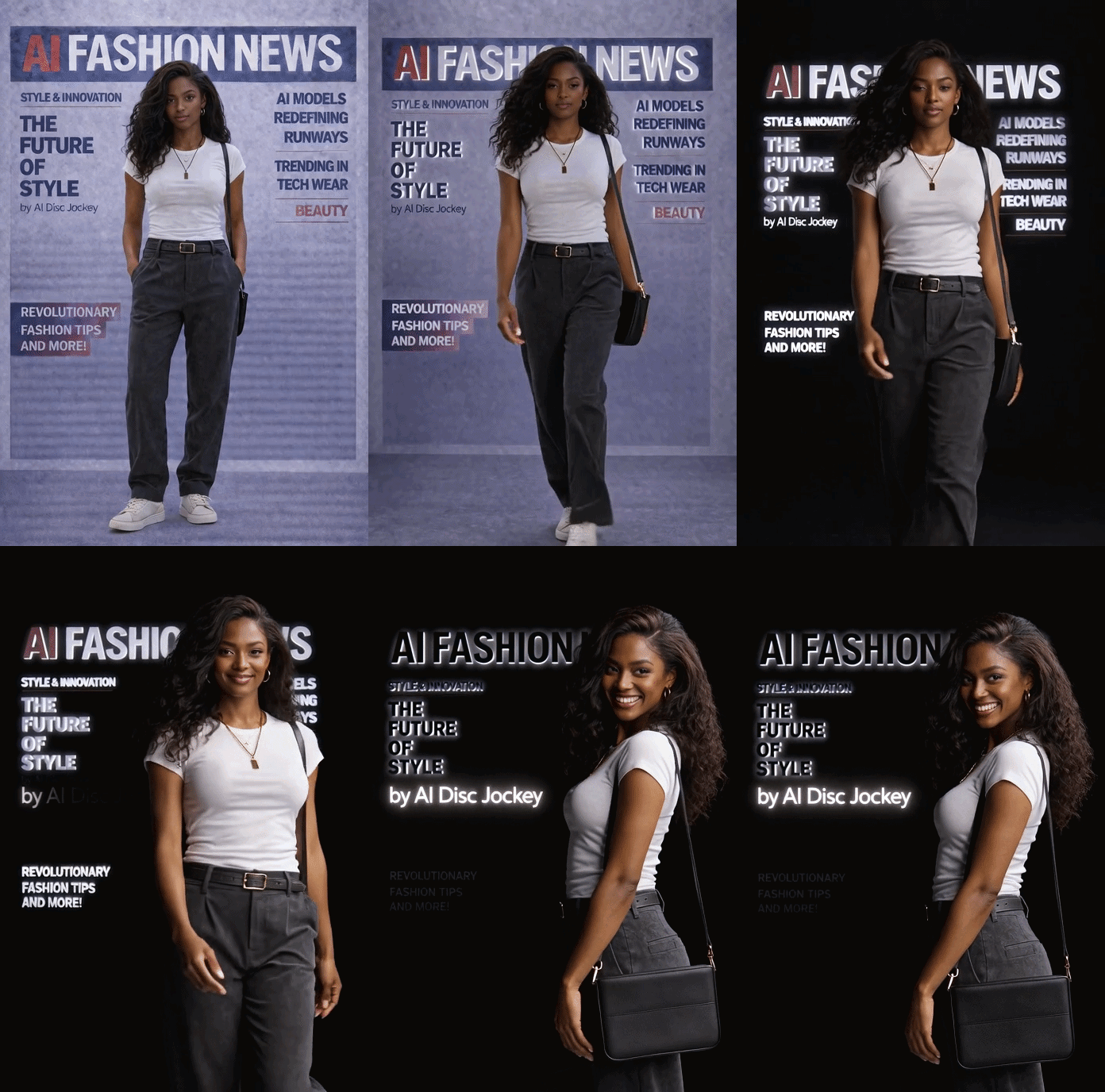
For the first time, AI in fashion and beauty is moving in two opposing directions at once. On one side, intelligence is embedding deeper into every layer of the industry — from styling and sizing to retail and identity. On the other, a cultural resistance is emerging, pushing back against synthetic perfection in favor of authenticity. This is no longer a linear evolution. It’s a defining tension between augmentation and rejection, automation and humanity. And that tension is beginning to shape strategy, brand positioning, and consumer behavior in real time.
Let’s get into it.
The Anti-AI Beauty Movement Goes Mainstream — Aerie draws a line
Aerie’s latest campaign marks one of the first large-scale rejections of AI-generated beauty in mainstream marketing. Featuring Pamela Anderson, the brand is doubling down on unretouched imagery and “real beauty” messaging. Business Insider writes that this isn’t just a creative decision — it’s a strategic stance against the rise of hyper-synthetic influencers and AI-generated faces dominating digital platforms. The campaign signals that some brands are no longer trying to compete with AI perfection — they are opting out of it entirely.
This introduces a new competitive dynamic in beauty. Instead of a universal push toward more advanced visuals, brands are now choosing sides: synthetic or authentic. As consumers become increasingly aware of manipulated imagery, authenticity itself may become a premium asset. The question is no longer “how real can AI look?” but “how much realness do consumers actually want?”
Why it Matters:
• The Anti-AI Beauty Movement Goes Mainstream
• Brands begin choosing between synthetic and real
• Authenticity becomes a strategic positioning lever
Revieve Launches “AI Skin Advisor” for Generative AI Platforms
Revieve announced on PRWeb that it is embedding beauty intelligence directly into conversational AI environments like ChatGPT. Its AI Skin Advisor allows brands to deliver fully customized skincare consultations within the chat interface, maintaining control over messaging, product recommendations, and tone. This is a critical shift — the consultation layer is moving from owned platforms into shared AI ecosystems.
What makes this particularly powerful is brand control. Instead of relying on generic AI outputs, companies can ensure that their identity and product positioning remain intact within the experience. This creates a new battleground where interaction — not just product — becomes the differentiator. The future of beauty retail may be less about websites and more about conversations.
Why it Matters:
• Branded AI consultations inside generative platforms
• Control of messaging within AI ecosystems
• Commerce shifts into conversational environments
AI Is Rewiring Fashion’s Art and Science
New data from Forbes shows that nearly 25% of consumers now begin their shopping journey using generative AI tools rather than traditional search engines. That shift fundamentally changes discovery. Instead of typing keywords, users are asking questions, describing needs, and expecting curated results. AI becomes the first touchpoint in the consumer journey.
At the same time, AI is influencing both sides of fashion — creative and commercial. Designers are using generative tools for concept development, while brands are using predictive analytics for demand planning. The distinction between art and science is dissolving. Fashion is becoming both engineered and imagined simultaneously.
Why it Matters:
• AI reshapes consumer discovery behavior
• Creative and commercial workflows converge
• Search evolves into conversational intent
AI Sizing Gets Smarter — MySize x EyeFitU Deal
The integration of MySize’s Naiz Fit platform with EyeFitU’s assets represents a significant advancement in sizing intelligence. By combining datasets and modeling capabilities, PR Newswire shares that the platform aims to deliver more accurate fit predictions across body types and brands. Fit has long been one of the biggest friction points in online fashion.
Improving sizing accuracy directly impacts profitability. Fewer returns mean lower costs, higher margins, and increased customer satisfaction. More importantly, it builds trust. When consumers feel confident in sizing, they are more likely to convert and remain loyal. Fit is no longer a feature — it’s foundational infrastructure.
Why it Matters:
• AI sizing becomes more precise and scalable
• Reduces returns and improves margins
• Fit intelligence drives customer confidence
“Vertical AI” Emerges as Fashion’s Profit Engine
Retail TouchPoints reported this week that Vertical AI represents a move toward industry-specific intelligence tailored to fashion’s unique dynamics. These systems ingest real-time signals — social sentiment, search trends, cultural shifts — to predict demand before it happens. This replaces reliance on historical data, which often lags behind real-world behavior.
The impact is operational and financial. Brands can produce closer to actual demand, reduce excess inventory, and respond faster to trends. AI becomes not just a tool for efficiency, but a direct driver of profitability. This is where intelligence shifts from support function to core business engine.
Why it Matters:
• Vertical AI transforms forecasting and inventory
• Real-time data replaces historical lag
• AI becomes a profit-driving engine
Legal Tension Rising: Who Owns AI-Generated Fashion?
As AI begins to generate designs, patterns, and visual assets, Taylor Wessing notes that legal systems are struggling to keep pace. Questions around ownership are becoming urgent. If an AI creates a design, who holds the rights — the brand, the developer, or the user who prompted it? These issues are no longer theoretical.
Without clear frameworks, brands face potential exposure in intellectual property disputes. At the same time, overly restrictive rules could slow innovation. The legal landscape is becoming a critical layer of AI adoption in fashion. Strategy now includes not just creation, but protection.
Why it Matters:
• Ownership of AI-generated designs remains unclear
• Legal frameworks lag behind innovation
• IP strategy becomes essential for AI adoption
Digital Fashion Week Taipei — AI, Gaming, and Commerce Converge
Covered EIN Presswire Digital Fashion Week Taipei is highlighting the convergence of AI, gaming, and commerce. The event brings together leaders in XR, digital identity, and virtual fashion to explore how avatars and digital garments are reshaping the industry. Fashion is evolving from product to experience.
This also signals a regional shift. Asia is leading in integrating immersive technology with commerce, creating ecosystems where digital and physical identities coexist. For global brands, this represents both an opportunity and a challenge. The future consumer may exist as much in virtual spaces as in physical ones.
Why it Matters:
• Fashion expands into gaming and virtual identity
• Asia leads immersive commerce innovation
• Digital garments become experiential assets
“AI Personality of the Year” Signals Mainstream AI Beauty Culture (The Tech Buzz)
This week the Tech Buzz focused on the rise of AI influencers is being formalized through global competitions recognizing synthetic personalities. These AI figures are no longer experimental — they are structured brands with narratives, engagement metrics, and partnerships. They function like full-scale media entities.
This reflects a broader shift in influence. Authenticity is being redefined. Instead of human origin, influence is increasingly measured by consistency, storytelling, and engagement. AI personalities can scale rapidly, operate continuously, and adapt instantly. The influencer economy is evolving into something hybrid.
Why it Matters:
• AI influencers become structured media brands
• Influence shifts toward hybrid identities
• Synthetic personalities scale faster than humans
Perfect Corp Unveils AI Beauty Agents at Shoptalk 2026
At Shoptalk 2026, Las Vegas Sun reported that Perfect Corp introduced advanced AI beauty agents designed to guide users through personalized shopping experiences. These agents can recommend products, simulate looks, and provide tailored advice across channels. The goal is continuity across the entire journey.
This represents a shift from search-based shopping to guided experiences. Instead of browsing, consumers are assisted in real time. AI becomes a digital advisor that travels with the user across platforms and environments. The experience becomes seamless and persistent.
Why it Matters:
• AI agents unify digital and physical retail
• Shopping becomes guided, not searched
• Personalization becomes continuous
Sephora Launches AI Experience Inside ChatGPT (Cosmetics Business)
Sephora is embedding its shopping experience directly within ChatGPT, allowing users to discover products and build routines without leaving the interface. This marks a major shift in retail distribution. The storefront is no longer a destination — it is an embedded layer.
This reduces friction and increases engagement. Consumers can move from discovery to decision instantly. For brands, this creates a new channel where presence inside AI ecosystems becomes critical. The interface itself becomes the marketplace.
Why it Matters:
• Retail embeds directly into AI platforms
• Discovery happens inside conversations
• The interface becomes the storefront
RELATED TECH AND INDUSTRY NEWS
Fitted App Brings AI Styling to Consumers (Forbes)
AI styling is moving directly into consumer hands through apps like Fitted, which allow users to experiment with outfits and refine personal style using AI recommendations. Born from viral momentum, this reflects growing demand for accessible styling tools. Personalization is no longer exclusive — it’s becoming a consumer expectation.
Real-Time AI Smart Mirrors Hit Retail
AI-powered smart mirrors are entering stores, allowing shoppers to try on outfits instantly using augmented reality. Systems like LOOOK.AI eliminate complex 3D modeling, making deployment easier for brands. Physical retail is becoming interactive, blending digital layers into in-store experiences.
AI Try-On Goes Mainstream in Formalwear
Virtual try-on is expanding into formalwear, with retailers enabling users to see tailored looks in seconds. This signals that AI fitting is moving beyond casual apparel into high-consideration purchases. Confidence becomes the key driver.
Gap Inc. Pushes AI-Powered Fit and Checkout
Gap is integrating AI across discovery, fit, and checkout to create seamless shopping experiences. The strategy focuses on meeting consumers “where inspiration happens,” signaling a move toward distributed commerce across platforms.
AI Styling Tools Go Viral
Google’s AI try-on tool is gaining traction, allowing users to visualize outfits on their own bodies. While excitement is high, questions around realism and overconsumption remain. As visualization improves, so does the responsibility to guide usage.
This week marks a defining split in the industry.
AI is accelerating across every layer of fashion and beauty — but so is resistance to it.
The future will not be purely synthetic or purely human.
It will be both.
The through-lines:
• AI vs authenticity becomes a defining tension
• Commerce moves into conversational and embedded environments
• Identity expands across human and synthetic forms
• Fit, forecasting, and personalization drive profitability
Stay ahead of the signal, not the noise.
—
This is the AI Disc Jockey…
Spinning signals where fashion meets the future.
Stay curious. Stay expressive. Stay original.
 ᴀɪ ᴅɪꜱᴄ ᴊᴏᴄᴋᴇʏ
Leave a comment