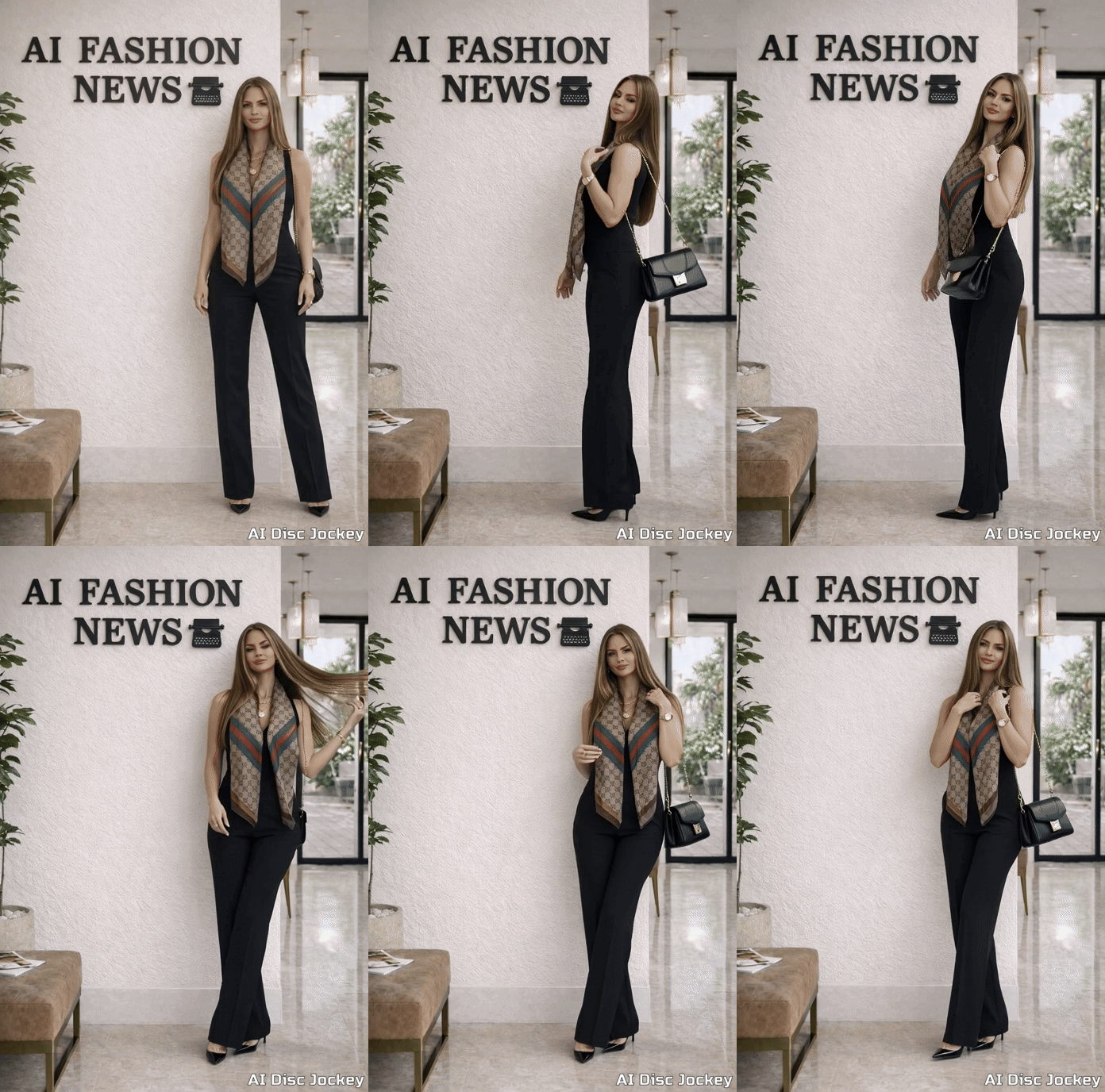
January 3, 2025 – January 10, 2025
By AI Disc Jockey | AI Fashion News — Where Creativity Meets Code – No 14
Where Algorithms Meet Aesthetics
Artificial intelligence is no longer a background utility in fashion—it’s becoming the operating system. From design studios and marketing departments to checkout flows and immersive retail environments, AI is actively reshaping how fashion is created, sold, and experienced. This week’s stories reveal a clear shift away from experimentation and toward execution, with 2026 shaping up as a defining inflection point for agent-led commerce, synthetic content, and personalized retail at scale. What’s emerging is a fashion industry that increasingly runs on predictive intelligence rather than reactive decision-making.
AI’s role in fashion is accelerating faster than many organizations are structurally prepared for. The brands that thrive will be those that invest early in adaptable systems, not just point solutions. The next phase of fashion innovation will belong to those who understand AI as a long-term strategic foundation, not a short-term efficiency play.
This week’s highlights.
AI Powering Fashion Innovation & Retail
AI’s influence across fashion retail is now end-to-end and featured in Ayre. What began as isolated personalization tools has evolved into interconnected systems that support design ideation, demand forecasting, merchandising, and customer engagement. The most forward-thinking retailers are treating AI not as a feature but as infrastructure—quietly orchestrating everything from product discovery to fulfillment behind the scenes. This shift signals a deeper organizational commitment to AI-led decision-making across the entire value chain.
- AI-driven virtual stylists are advancing from novelty to conversion engines
- Inventory forecasting models are reducing overproduction and markdown risk
- Autonomous shopping agents are beginning to act on behalf of consumers, not just advise them
- Retailers are connecting AI insights across digital and physical touchpoints
The implication is clear: fashion brands that fail to integrate AI holistically risk falling behind those building intelligent, adaptive retail ecosystems. As these systems mature, competitive advantage will increasingly come from how well brands connect data, creativity, and execution. In this new landscape, AI fluency becomes a core leadership competency, not just a technical skill
AI-Generated Fashion Photography Market Growing Fast
Yahoo highlighted that AI-generated fashion imagery is no longer a fringe experiment—it’s a rapidly expanding global market. With projected growth from $1.51B in 2024 to $2.01B in 2025, synthetic photography is reshaping how brands produce content for e-commerce, social platforms, and performance marketing. Speed, scale, and flexibility are driving adoption as brands race to meet content demands across channels.
- Faster content production cycles with lower costs
- Infinite variation for A/B testing and localization
- Reduced dependency on traditional photoshoots
- Rising questions around authenticity, ownership, and creative control
As AI visuals become indistinguishable from traditional photography, brands will need to define new standards for transparency, creative ethics, and brand trust. The conversation is quickly shifting from “can we use AI imagery?” to “how do we use it responsibly and distinctively?” Those answers will shape consumer perception for years to come.
AI Shopping Agents Enter the Mainstream
2026 Becomes the Make-or-Break Year for Agent-Led E-Commerce
Shopping agents are moving from experimental demos into real-world commerce flows as reported by Modern Retail. Retailers, startups, and tech giants are racing to deploy AI agents capable of researching products, comparing prices, learning preferences—and in some cases—completing purchases autonomously. This evolution reflects a broader push to reduce friction and cognitive overload in digital shopping experiences.
What’s accelerating adoption:
- Consumer fatigue with endless choice
- Improvements in agent reliability and explainability
- Retailer demand for higher conversion and retention
- Platform-level investment from major tech players
2026 is shaping up as the year when consumers decide whether AI agents become trusted shopping partners—or just another abandoned interface. Trust, transparency, and perceived value will determine adoption far more than technical sophistication alone. Brands that respect consumer agency while offering genuine utility will lead this transition.
Rezolve AI Agents Take Center Stage at NRF 2026
The Manila Times brings readers attentions to Rezolve AI’s presence at NRF 2026 underscores a growing focus on agentic commerce—AI systems designed to automate entire customer journeys rather than isolated tasks. These enterprise-grade agents promise to streamline ordering workflows, personalize engagement, and reduce operational friction across fashion retail. The emphasis is shifting toward AI that can act, not just assist.
Why retailers are paying attention:
- AI agents that operate across channels and devices
- Automation of repetitive customer interactions
- Scalable personalization for enterprise commerce
- Faster path from discovery to purchase
This signals a shift from “AI-assisted retail” to AI-orchestrated retail. As agentic systems become more autonomous, governance and oversight will become just as important as performance. Retailers that define clear guardrails early will be best positioned to scale responsibly.
Retail Tech Goes Immersive
Datavault AI’s collaboration with luxury retailer Riflessi points to the next evolution of physical retail. Beginning February 2026, holographic displays and spatial audio will transform store environments into immersive brand storytelling platforms—blending digital fashion, experiential marketing, and data-driven insights. This approach repositions brick-and-mortar stores as high-impact experiential destinations rather than transactional spaces.
- Physical stores are becoming experiential media channels
- Immersive tech bridges digital and in-store engagement
- AI-driven metrics will quantify emotional and sensory impact
- Luxury retail continues to lead experiential innovation
Retail’s future isn’t digital-only—it’s digitally enhanced physical space. Immersive technologies give brands new ways to communicate identity, craftsmanship, and emotion. Those who execute well will turn stores into living brand narratives rather than static showrooms.
What Happens to Personal Style in the Age of AI-Powered Shopping?
As AI increasingly curates what consumers see, try, and buy, questions around individuality and self-expression are intensifying. While personalization promises relevance and convenience, there’s a growing concern that algorithmic recommendations could homogenize taste rather than celebrate uniqueness. The balance between guidance and creative freedom is becoming a defining issue for modern retail.
The tension at play:
- Efficiency vs. creativity
- Recommendation engines vs. serendipity
- Trend acceleration vs. personal identity
The brands that win will be those that design AI systems to amplify personal style, not replace it. Giving consumers tools to explore, remix, and surprise themselves will matter more than pushing optimized defaults. In the age of intelligent shopping, individuality becomes the ultimate luxury.
Fashion Brands Using AI
A comprehensive look at 25 fashion brands deploying AI across design, personalization, inventory management, and marketing highlights how quickly competitive advantage is shifting. What once separated innovators from followers is now becoming a baseline expectation. Execution speed and organizational alignment are emerging as key differentiators.
Common patterns among AI leaders:
- Centralized data infrastructure
- Cross-functional AI deployment
- Clear ROI measurement
- Strong human–AI collaboration models
This list serves as a practical benchmark for brands assessing where they stand—and how fast they need to move. AI maturity is no longer about experimentation; it’s about operational excellence. Brands that delay risk being locked out of the next phase of retail evolution.
Fashion Industry in the Next 5 Years
Looking toward 2030, AI-driven recommendations, virtual try-on, and intelligent commerce platforms are expected to redefine personalization and customer loyalty. The industry is moving toward predictive, adaptive retail experiences that anticipate needs before consumers articulate them. This transformation will reshape not only how products are sold, but how brands build long-term relationships.
The long-term outlook:
- Hyper-personalized shopping journeys
- Virtual-first product testing
- Reduced waste through smarter forecasting
- AI as a core brand differentiator
The next five years will reward brands that treat AI as a strategic growth engine rather than a tactical upgrade. Those who invest in trust, transparency, and creativity alongside technology will define the next era of fashion retail. By 2030, intelligence won’t just power fashion—it will shape its identity.
This week’s stories collectively reveal a fashion industry crossing a critical threshold—from AI as a supportive layer to AI as an autonomous force shaping decisions, experiences, and outcomes. Across retail, content creation, immersive environments, and commerce workflows, intelligence is becoming embedded, proactive, and increasingly agent-driven. Whether through virtual stylists, synthetic photography, immersive stores, or shopping agents acting on behalf of consumers, the industry is shifting toward systems that anticipate needs, reduce friction, and operate continuously across channels. At the same time, these advances surface fundamental questions around trust, creativity, and individuality, making it clear that technological acceleration must be matched with thoughtful design, governance, and brand intent.
Fashion’s next era will not be defined by how much AI is deployed, but by how intentionally it is applied. The winners will be brands that treat intelligence as both a creative collaborator and a strategic steward—balancing automation with emotion, personalization with self-expression, and efficiency with meaning. As 2026 approaches, AI is no longer simply powering fashion behind the scenes; it is actively shaping how style is discovered, expressed, and experienced. The opportunity now is to ensure that as fashion becomes smarter, it also becomes more human.

Stay curious.
Stay expressive.
And above all—
Stay original.
 ᴀɪ ᴅɪꜱᴄ ᴊᴏᴄᴋᴇʏ
Leave a comment