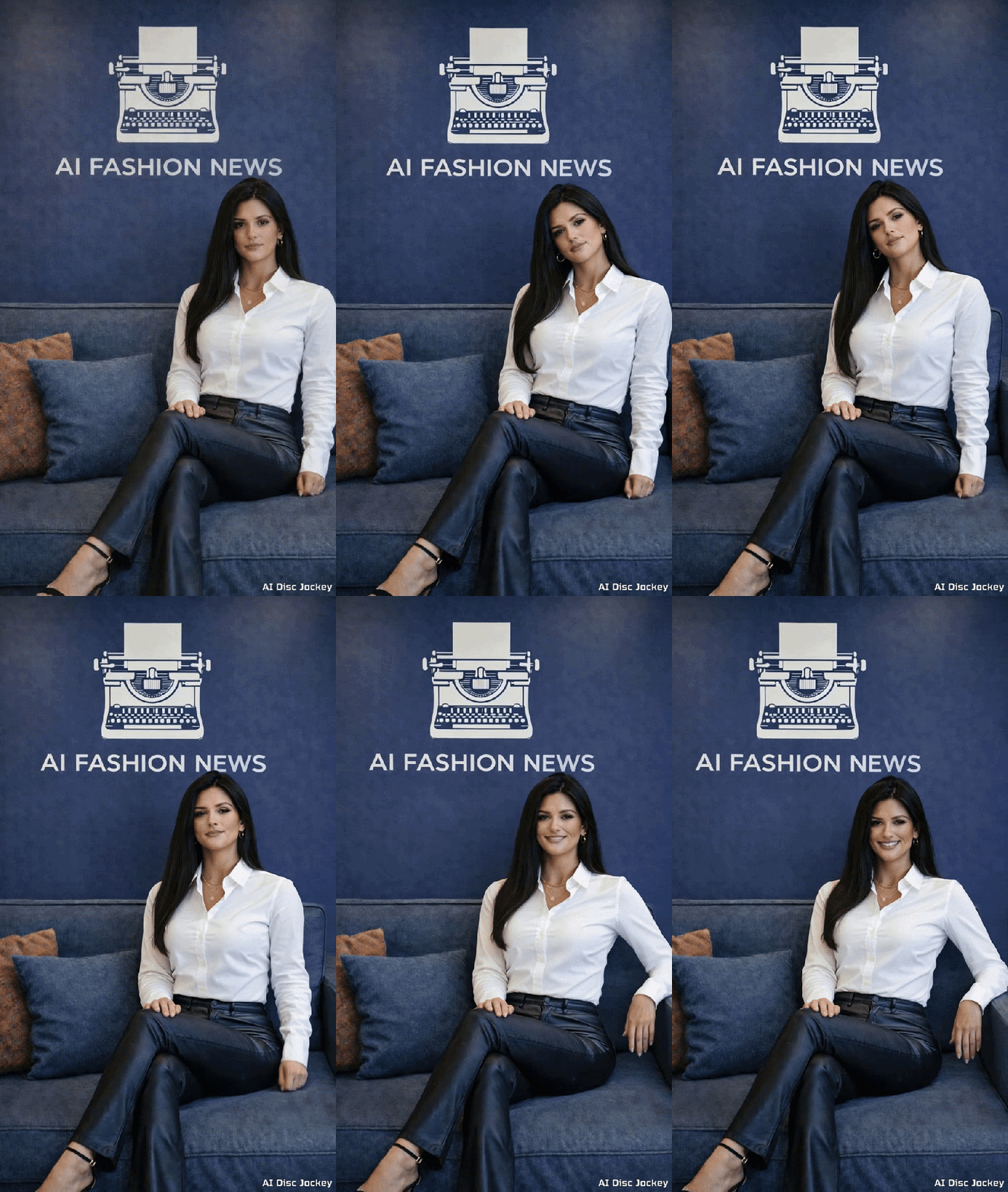
December 28, 2025 – January 3, 2025
By AI Disc Jockey | AI Fashion News — Where Creativity Meets Code – No 13
This week at AI Fashion News Fashion’s relationship with AI is no longer theoretical—it’s operational, experiential, and increasingly personal. This week’s stories reveal a clear inflection point: AI is moving from supporting creativity and commerce to participating in decision-making, design, and even representation. From autonomous shopping agents to virtual stylists and synthetic models, the industry is quietly rewriting its own rules. Below, we break down what matters—and why it signals where fashion is headed next.
This week’s highlights.
AI Will Change the Way You Shop in 2026
Fast Company reports that AI-powered recommendations are evolving into something far more consequential: AI as a purchasing agent. Rather than suggesting products, future systems may soon buy on behalf of consumers—within budgets, preferences, and ethical constraints you define. This transition reframes shopping as an outcome-driven experience instead of a time-intensive activity, where convenience and trust outweigh discovery.
This marks a psychological and commercial shift. Shopping becomes less about browsing and more about delegation—turning AI into a trusted proxy for taste, timing, and value. As consumers grow more comfortable outsourcing decisions in finance, travel, and media, fashion is the next frontier for automation-driven confidence.
- AI shopping agents will monitor price drops, restocks, fit history, and sustainability preferences automatically, removing friction from repeat purchases
- Personalized “shopping profiles” will replace one-size-fits-all recommendation engines, evolving continuously as lifestyles change
- Retailers must now design for machines as customers, not just humans, optimizing data clarity and product logic
- Brand loyalty may shift from labels to the AI systems consumers trust most, fundamentally altering customer acquisition dynamics
The winners won’t just be brands with the best products—but those whose data, storytelling, and ethics are legible to AI systems making autonomous decisions. In the near future, brand visibility may depend as much on algorithmic compatibility as on consumer desire.
Lane Crawford & AiDLab Launch an Interactive AI Stylist
Luxury retail is stepping confidently into AI-powered personalization. Lane Crawford’s new interactive AI stylist that blends digital intelligence with high-touch luxury is featured inPan African Visions. It brings curated fashion guidance into both online and in-store environments. This move signals that personalization is no longer a premium add-on, but a baseline expectation for luxury consumers.
This isn’t about novelty. It’s about scaling intimacy—delivering bespoke styling at enterprise scale without sacrificing brand voice. As foot traffic fluctuates globally, AI-powered continuity ensures the customer relationship remains intact across channels.
- AI stylist adapts to body type, style preferences, occasion, and past purchases, refining its guidance with each interaction
- Bridges physical retail with digital continuity (in-store + online memory), creating a seamless luxury journey
- Enhances sales associates rather than replacing them, freeing staff to focus on relationship-building
- Signals AI’s growing role in experiential luxury, not just e-commerce, where service defines differentiation
Luxury’s edge has always been service. AI now becomes a multiplier—extending craftsmanship into the realm of data-driven personalization while preserving the emotional resonance that defines high-end retail.
Are AI-Generated Models Going to Replace Human Ones?
The rise of AI-generated fashion models raises uncomfortable—but necessary—questions around labor, ownership, and creative control. was raised by L’Officiel Philippines. Synthetic faces are cheaper, infinitely flexible, and immune to logistics—but at what cost? The conversation now extends beyond efficiency into cultural responsibility.
Fashion imagery shapes culture. Replacing humans with algorithms isn’t just a production decision—it’s a values statement. Brands must now weigh cost savings against authenticity, representation, and long-term brand trust.
- Brands gain full control over image rights and reusability, reducing legal complexity and scheduling constraints
- Human models face displacement concerns similar to creatives in music and art, sparking calls for new protections
- New IP, consent, and likeness laws remain unresolved, creating regulatory gray zones
- Synthetic diversity risks becoming performative rather than lived, reinforcing stereotypes if poorly executed
AI models won’t fully replace humans—but they will force the industry to redefine authenticity, representation, and fairness in visual culture. The brands that lead responsibly will shape not just campaigns, but public perception of AI itself.
How AI Is Transforming Fashion Design & the Entire Supply Chain
The Economic Times reminds us that AI is no longer confined to mood boards and trend forecasting—it’s now embedded end-to-end across the fashion value chain, from concept to consumer. What was once experimental is rapidly becoming infrastructural.
Operational AI is becoming a competitive necessity, not a differentiator. Brands that delay risk structural inefficiency, slower reaction times, and excess waste in an increasingly volatile global market.
- Generative AI accelerates design iteration and prototyping, compressing timelines from months to weeks
- Predictive analytics reduce overproduction and inventory waste, aligning output with real demand
- AI improves demand forecasting and regionalized assortments, supporting localization at scale
- Supply chains become faster, leaner, and more resilient, particularly amid geopolitical and climate disruptions
This is where AI delivers its quietest—but most profound—impact: reshaping fashion’s economics beneath the surface. The brands that master operational intelligence will gain long-term strategic advantage, not just short-term efficiency.
AI in fashion is no longer about experimentation—it’s about integration. What we’re witnessing is a systemic shift where intelligence is woven into every layer of the industry, visible or not.
- AI is becoming a shopper, a stylist, a model, and a supply-chain strategist, expanding its influence across touchpoints
- Brands must now design for trust, transparency, and machine interpretation as much as human emotion
- Creativity remains human—but execution is increasingly hybrid, collaborative, and data-informed
As we move toward 2026, fashion’s future won’t be defined by who uses AI—but by who uses it with intention, responsibility, and vision.

Stay curious.
Stay expressive.
And above all—
Stay original.
 ᴀɪ ᴅɪꜱᴄ ᴊᴏᴄᴋᴇʏ
Leave a comment